
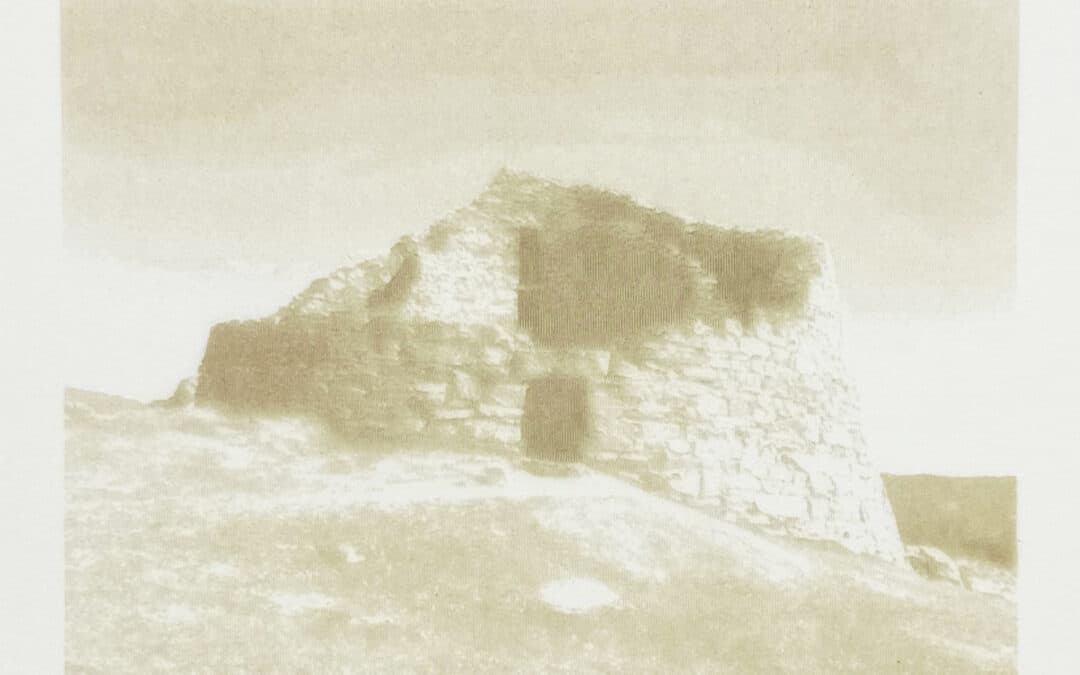
Just found out I have a new print selected for this year’s Royal Academy Summer Exhibition 16 June – 23 August 2026
I believe there were 18,000 applications world wide and i’m delighted to be exhibiting a wee bit of the Outer Hebrides on the walls of the Royal Academy, this year. This is the third time I have been selected for the Summer Exhibition and although I will not make the Varnishing Day this years, due to the distance form the Hebrides to London, I am looking forward to seeing the work in July when I am on my mainland road trip.
So what is this image about?
It is limited edition, laser engraved print. One of a series of new laser engraved images called “Postcards from the Past” which depict elements of my day to day life living and working on the Isle of Lewis in the Outer Hebrides.
My work explores what the definition of drawing can be, in its broadest sense. For the creation of this series of prints she investigates the use of a laser cutter as a drawing medium. The sepia, almost Victorian quality of the image, evokes the rich history of the western isles, whilst the use of contemporary digital technology to create the image, aims to intentionally unsettle the viewers sense of time.
Dun Carloway (in Gaelic, Dùn Chàrlabhaigh or An Dùn Mòr) is an Iron Age monument on the Isle of Lewis, which I see each day from my studio window. It is the best-preserved example of a Broch in the Western Isles, and among the tallest in Scotland as a whole. The broch stands on a rocky knoll above a small loch, with views towards Loch Roag, an inlet of the Atlantic.
Brochs are typified by a circular ground plan with massive drystone walls capable of rising to tower – like heights – in the case of Dun Carloway, around nine metres. Intra-mural passages or ‘galleries’, stairways and chambers also characterise Brochs, which are unique to Scotland and of late Iron Age date. Brochs began to be constructed at a date between 400 and 200 BC.